Power Cuts, Bandwidth Gaps, and Dry Taps: Quantifying Algeria's Utility Risk for US Manufacturers
The Infrastructure Gap That Doesn't Appear in the Pitch Deck
Algeria's investment promotion narrative is, in many respects, compelling. A large domestic consumer market, competitive labor costs relative to European manufacturing alternatives, proximity to Mediterranean trade routes, and an active government push toward industrial localization create a genuine case for US manufacturing investment. What the official investment materials rarely quantify is the operational cost imposed by Algeria's soft infrastructure — the electricity grid, internet backbone, and municipal water systems that determine whether a production facility can run reliably, at scale, and on schedule.
For light assembly, service delivery, or trading operations, utility disruptions are an inconvenience. For precision manufacturing, cold chain logistics, data-dependent service operations, or any process with continuous-run requirements, they are a fundamental business risk that must be modeled into the investment case before capital is committed.
Electricity: The Most Quantifiable Variable
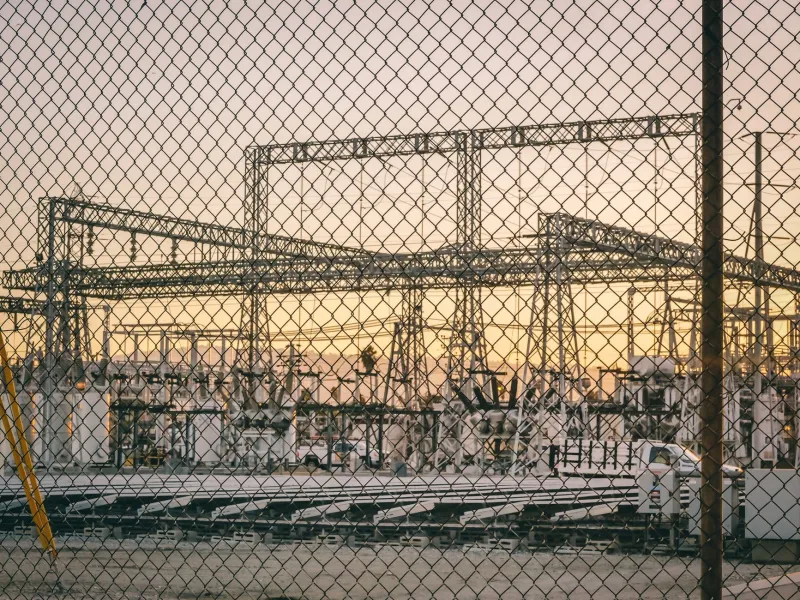
Algeria's national electricity grid, operated by Sonelgaz, serves the country's industrial and residential load from a generation base that is overwhelmingly dependent on natural gas. Total installed generation capacity has grown substantially over the past decade, and Algeria is not a country that experiences chronic nationwide blackouts. The problem for industrial operators is not systemic collapse — it is frequency and unpredictability of localized disruptions.
Industrial zones outside Algiers and Oran, particularly in the interior wilayas, experience load shedding events that can range from hourly interruptions during peak summer demand to multi-day outages following infrastructure failures. The summer months — when residential air conditioning demand spikes simultaneously with industrial load — represent the highest-risk period. Voltage fluctuations, which are distinct from outages but equally damaging to sensitive equipment, are reported across industrial zones with sufficient frequency that equipment warranty considerations become a real procurement factor.
The financial cost of electricity unreliability takes several forms. Direct production loss during outage events is the most visible. Equipment damage from voltage irregularity — particularly for CNC machinery, injection molding equipment, and electronics manufacturing tools — represents a less visible but potentially larger cost. Restart costs for continuous-process operations (chemical processing, certain food manufacturing, glass production) can be substantial when a line must be shut down and restarted rather than simply paused.
US manufacturers operating in Algeria almost universally invest in diesel backup generation. The capital cost of an appropriately sized generator set for a mid-scale manufacturing facility ranges from $80,000 to $400,000 depending on capacity. Diesel fuel costs, maintenance contracts, and the operational overhead of managing a backup power system add a recurring expense that does not appear in the pro forma models of companies that underestimate utility risk.
Internet Connectivity: A Growing Constraint for Data-Dependent Operations
Algeria's internet infrastructure has expanded significantly, driven by both state investment and the growth of mobile data networks. For consumer-facing digital businesses, connectivity has improved to a point where it supports basic e-commerce and service delivery. For US companies with enterprise-level requirements — real-time ERP integration, cloud-based manufacturing execution systems, video-based quality control, or remote monitoring of distributed operations — the picture is more complicated.
Fixed-line broadband penetration remains uneven, and fiber connectivity outside major urban centers is limited. International bandwidth capacity, while growing, creates latency and throughput constraints for applications that require sustained high-speed connections to US-based servers. Redundant connectivity — combining a primary fixed connection with a secondary LTE or satellite link — is standard practice among sophisticated operators and adds approximately $1,500 to $4,000 per month in recurring costs for a facility with enterprise-level requirements.
The 2021 introduction of Starlink and subsequent expansion of low-earth-orbit satellite connectivity has created new options for facilities in locations where terrestrial connectivity is genuinely inadequate, though regulatory approval for satellite internet services in Algeria remains a variable that operators should verify with current legal counsel.
Water: The Underestimated Constraint
Water supply receives less attention in market entry discussions than electricity or internet, but for manufacturing processes with significant water requirements — food and beverage production, textile dyeing, pharmaceutical manufacturing, metal finishing — it represents a critical operational variable.
Algeria's municipal water systems in major cities are generally functional but subject to pressure fluctuations and periodic supply interruptions, particularly during summer months and in secondary cities experiencing rapid population growth. Industrial zones that draw from municipal supply rather than dedicated industrial water infrastructure face the highest exposure.
US manufacturers with water-intensive processes should assess, prior to site selection, whether a facility location offers access to industrial water infrastructure, the feasibility of on-site water storage (typically 24 to 72 hours of operational buffer), and whether water treatment or recycling requirements apply under local environmental regulations. These are not hypothetical concerns — they are site selection criteria that experienced operators treat as non-negotiable.
Pricing Utility Risk Into the Investment Model
The practical implication of Algeria's utility environment is not that investment is inadvisable — it is that the true cost of operations must be modeled with infrastructure redundancy built in from the start.
A realistic cost model for a US manufacturer entering Algeria should include: capital expenditure for backup power generation (sized to full operational load, not partial); recurring fuel and maintenance costs for that system; redundant internet connectivity with appropriate failover configuration; on-site water storage sufficient for at least 48 hours of production continuity; and an operational contingency reserve — typically 8 to 12 percent of projected annual operating costs — to absorb disruption events that fall outside planned redundancy.
Companies that build these costs into their initial pro forma arrive at more accurate IRR projections and, critically, make better site selection decisions. Facilities located in established industrial zones with dedicated infrastructure — including the Bellara steel complex zone in Jijel, the Arzew petrochemical corridor, and several purpose-built zones near Oran — offer meaningfully better utility reliability than greenfield sites in less-developed areas.
Algeria's infrastructure is improving, and the government's investment in grid modernization and water treatment capacity is real. But improvement trajectories are not operational guarantees, and US companies that plan for the Algeria that exists today — rather than the Algeria that development plans project — will find themselves better positioned to protect their capital and deliver on their production commitments.